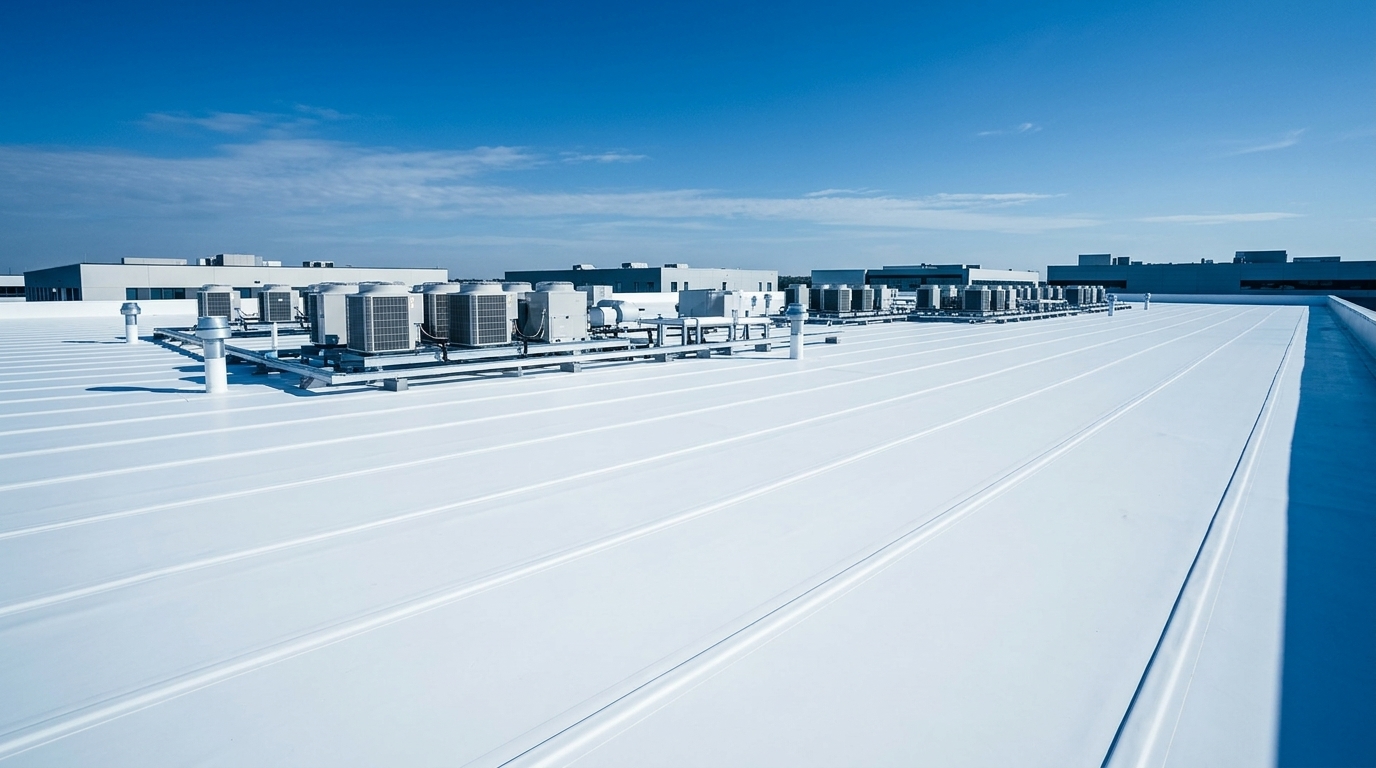
Commercial flat roofing in Minneapolis needs drain attention before fall leaves and snow season. Here's what property managers should check now.
There's a narrow window every September when the drainage system on a Minneapolis commercial flat roof can be properly assessed, cleared, and prepared before the combination of fall leaf debris and early snow creates the kind of blockage that causes ponding, ice loading, and eventually interior water damage. Commercial flat roofing in Minneapolis is a maintenance category where timing genuinely matters, and fall drain preparation is the single most time-sensitive item on the annual maintenance calendar.
The Short Answer: Why Fall Drain Maintenance on Minneapolis Commercial Roofs Can't Wait
Commercial flat roofing in Minneapolis faces a specific fall hazard that doesn't exist at the same scale in warmer climates: leaves and organic debris accumulate on the roof surface in September and October, migrate toward drains and scuppers under wind and rain, and begin creating blockages right before the period when proper drainage is most critical. Snow that falls on a roof with partially blocked drains has nowhere to go as it melts during freeze-thaw cycles, creating ponding under the snow layer that adds structural load and drives water against every seam and penetration it contacts. Getting drains cleared and assessed in September rather than October or November is the margin that separates a well-managed flat roof from one that develops a winter leak.
What Property Managers Usually Notice First
Commercial property managers in Minneapolis tend to discover flat roof drainage problems in one of two ways: a tenant reports a ceiling issue after a sustained rain event, or a rooftop walkthrough during a spring inspection reveals signs of winter ponding that weren't there in the fall. Neither of these is a good way to learn about a drain that needed attention in September.
Warning signs that often appear before a drain failure causes an interior event:
- Roof membrane that has developed a visible depression or discoloration around a drain location, visible on an adjacent building or upper-floor exterior
- Slow gurgles or delayed drainage audible through the roof deck during heavy rain, indicating a partial blockage in the drain body
- Debris lines or sediment rings on the membrane surface around drains, indicating where the waterline sat during a previous ponding event
- Parapet walls with water mineral staining at low points, showing where overflow has been reaching the wall surface
What property managers often miss is that commercial flat roofing in Minneapolis drain issues develop gradually over a full season before they produce an interior event. A drain that is 70 percent blocked doesn't fail dramatically. It fails incrementally, handling light rain adequately while backing up during heavier events, building a pattern of marginal ponding that gets slightly worse with each storm until a threshold is crossed.
What a Roofing Contractor Looks For During Fall Drain Preparation
On many fall maintenance visits to commercial flat roofing in Minneapolis, we find that the visible drain cover condition tells only part of the story. The drain body, the deck slope into the drain, and the overflow path are all part of a drainage system that needs to be evaluated together, not just the surface component.
Here is what a thorough fall drain assessment on a Minneapolis commercial flat roof actually involves:
Physical flow testing at every drain. We test each primary drain by simulating water flow and measuring actual throughput, not just confirming the drain cover is debris-free. Drain bodies can accumulate sediment, roofing gravel, biological growth, and even roofing material residue from past repairs that restricts flow without blocking the cover completely. Physical testing catches partial blockages that visual inspection misses.
Scupper condition and overflow capacity. Scuppers, the through-wall openings in parapet walls that serve as secondary drainage paths, are often overlooked during routine maintenance because they're less visible than primary roof drains. We check every scupper for debris accumulation, paint-over from past exterior maintenance that has partially sealed the opening, and outlet extensions that have become clogged at the wall face.
Deck slope integrity around drain locations. Commercial flat roofing in Minneapolis that has experienced seasons of ponding around a drain can develop deck deflection that has actually reversed the slope immediately adjacent to the drain, creating a low point that holds water rather than feeding it into the drain. We assess deck slope condition during every fall visit because this finding changes the maintenance recommendation from drain clearing to a more involved structural drainage correction.
Leaf guard and drain cover specification. We evaluate whether the existing drain covers and any leaf guards are appropriate for the building's debris load profile. A building surrounded by mature deciduous trees in Minneapolis may benefit from a different drain cover configuration than a building in an open industrial park, and fall is the right time to make that assessment before leaves begin falling in volume.
Membrane condition at drain terminations. The junction where the roof membrane meets the drain body is the most stressed waterproofing point in the entire drainage system. We check this interface for lifting, cracking, or separation, and for the condition of any drain flashing collar that forms the sealed connection between the two.
A roofing contractor assessing commercial flat roofing in Minneapolis for fall readiness is not just running a maintenance checklist. They're evaluating the drainage system's ability to manage the specific precipitation and debris load it's about to face over the next five months.
Why Fall Timing Is Uniquely Important for Minneapolis Commercial Roofs
Minneapolis trees, which include a high proportion of deciduous species in both commercial and residential areas, shed a significant volume of leaf debris in September and October. According to the City of Minneapolis forestry data, the urban tree canopy in the city is substantial, and commercial buildings surrounded by or adjacent to tree-heavy areas accumulate rooftop debris at a rate that can partially block drains within a single significant rain event during peak leaf fall.
The timing window for commercial flat roofing in Minneapolis fall drain preparation is narrow for this reason. September provides the last reliable opportunity to clear and assess drains before leaf fall volume peaks, and before temperatures drop enough to make certain repair and maintenance procedures less reliable. A drain that is cleared and tested in September can handle October's leaf debris load with some protective capacity. A drain that enters October already partially blocked by summer sediment has no reserve capacity when the leaf volume arrives.
According to NOAA precipitation data for the Twin Cities metro area, September and October bring meaningful rainfall totals to Minneapolis, transitioning from summer's intense short-duration events to the more sustained, moderate-intensity rainfall associated with fall weather systems. For commercial flat roofing in Minneapolis, this shift in precipitation character means water sits on the roof longer, testing drainage system capacity more thoroughly than summer's brief heavy events typically do.
A Minneapolis Property Manager's Fall Drain Story
A facilities manager for a commercial office building near the Warehouse District reached out in early October the previous year after a tenant on the third floor reported ceiling tile discoloration following a sustained overnight rain. The building had a TPO flat roof that had been maintained reasonably well, and the manager was surprised that a drainage issue had developed without any prior indication.
When we inspected, we found three of the building's six primary drains had significant sediment accumulation in the drain body, not in the drain cover, that was restricting flow to well below the design capacity. The building is located adjacent to a city boulevard with significant tree coverage, and the summer and early fall had delivered substantial organic debris to the roof that had washed into the drain bodies during rain events.
We cleared all six drains, physically tested flow at each one, and identified one drain where the membrane-to-drain collar interface had also begun to separate, a finding that required a targeted repair beyond the drain clearing itself. The third-floor ceiling tile damage was minor and directly attributable to the drainage restriction. The same situation left through another month of October rain would have resulted in more significant ponding and a larger interior event. Commercial flat roofing in Minneapolis drain preparation in September rather than reactive response in October would have prevented the interior event entirely.
Common Mistakes Commercial Property Owners Make With Fall Drain Maintenance
Scheduling drain cleaning only after a problem appears. Commercial flat roofing in Minneapolis drainage should be on a scheduled maintenance calendar, not a reactive task list. By the time a drain failure produces an interior symptom, the membrane at the ponding zone has typically been under stress for multiple events.
Cleaning only the drain covers without clearing the drain body. A clean drain cover over a partially blocked drain body creates false confidence. The restriction that matters to drainage performance is in the body and the outlet connection, not the surface screen.
Assuming summer maintenance visits covered fall preparation. A summer roof inspection focused on storm damage and seam condition addresses different things than fall drain preparation. These are separate maintenance tasks that serve different purposes.
Skipping scupper inspection because the primary drains seem functional. Scuppers are the overflow path when primary drain capacity is exceeded. On a building where primary drain capacity is already partially compromised, functional scuppers are the last line of defense against significant ponding accumulation during a heavy rain event.
Set Up a Commercial Roof Drain Inspection Before Leaves and Snow Pile Up
If your Minneapolis commercial building hasn't had a fall drain assessment yet, the September window is the most effective time to act before leaf volume peaks and before early snow events begin testing the drainage system under full load. Altus Construction provides fall commercial flat roofing maintenance across Minneapolis and the wider metro area, with physical drain testing, scupper assessment, and membrane condition evaluation at every drain termination. Schedule your commercial flat roofing inspection today and get your drainage system prepared before leaves and snow make the same job more difficult and more urgent.
Visit us in St. Louis Park, MN, we're based locally and know what Minneapolis's tree canopy and fall weather pattern do to commercial flat roof drainage systems.
Frequently Asked Questions
How often should commercial flat roofing in Minneapolis have drain maintenance performed?
At a minimum, twice annually: a spring inspection after winter conditions have cleared, and a fall preparation visit in September before leaf volume peaks and before winter precipitation begins. Buildings with significant adjacent tree coverage or known drainage challenges may benefit from an additional mid-summer check, particularly after any storm event that delivered significant debris to the roof. Flat roofs that receive only reactive maintenance after interior events are consistently more expensive to maintain over a five-year period than those on a scheduled inspection cycle.
Can leaves actually cause significant drainage problems on a commercial flat roof in Minneapolis?
Yes, and more quickly than most property managers expect. A single significant rain event during peak leaf fall can deposit enough debris around drain covers to restrict flow to a fraction of design capacity. Commercial flat roofing in Minneapolis adjacent to boulevard trees or park areas can accumulate leaf cover across the roof surface within one windy October day, creating drainage restriction across multiple drains simultaneously rather than a single localized blockage.
What happens to commercial flat roofing in Minneapolis if drains are blocked when snow arrives?
Snow that accumulates on a flat roof with blocked drains melts during freeze-thaw cycles and has nowhere to go. The melt water ponds under the snow layer, adding structural load to the roof deck and maintaining prolonged water contact with membrane seams and penetration seals. When temperatures drop again, that standing water freezes and expands in every membrane gap it has found, widening those gaps for the next thaw cycle. This compounding mechanism can turn a modest drainage restriction into a significant membrane failure event over a single Minneapolis winter.
Is fall drain maintenance covered under a commercial roofing warranty?
Commercial flat roofing in Minneapolis warranties, whether manufacturer or workmanship, typically have maintenance requirements that must be met for the warranty to remain valid. Neglecting scheduled drain maintenance could be cited as a contributing factor if a warranty claim is submitted for a leak that developed from drainage-related membrane deterioration. Keeping records of maintenance visits, including drain clearing and flow testing, is part of maintaining warranty compliance as well as the roof itself.

David Armenta Magana, Owner.